
How do you read a mill test report?
At some point you're standing at receiving with a box of bolts in one hand and a PDF in the other, and the question is simple: are these the parts I ordered?
The mill test report is the document that answers it. Most buyers are never taught to read one. It gets forwarded to quality, or filed, or skimmed for a signature and forgotten until an auditor asks. That's a shame, because reading one takes about two minutes once you know where to look, and you're the one who writes the cert requirement onto the purchase order and decides whether to accept what showed up.
What a mill test report actually is
A mill test report, sometimes called an MTR, a mill cert, or a material test report, is a record of test results performed on a specific batch of material. It reports what that material actually measured, not what it was supposed to measure. The producer issues it, and it stays tied to that batch through a heat number.
The heat number identifies the specific melt of steel the material came from, and it's the thread that connects the paperwork in your hand to the parts in the box. Without it, a certificate is a document about some material somewhere. With it, you can prove the parts on your floor came from a batch that was tested and passed.
The difference between a mill test report and a certificate of conformance
These two get used interchangeably, and they aren't the same thing. When your customer or your registrar asks for one specifically, sending the other won't do.
A certificate of conformance, sometimes a CoC, is a statement. A supplier signs it to say the material meets a named specification, and it doesn't have to show you the measurements behind that claim. Some suppliers attach data or reference a test report; plenty don't, and nothing requires them to.
A mill test report is evidence. It shows the measured chemistry and mechanical results for a specific heat, and you can compare them yourself against the spec limits.
If your contract, your customer, or your quality system calls for material traceability, a certificate of conformance usually won't satisfy it. It goes like this: the buyer asks for certs, the supplier sends a conformance letter, everyone files it, and nobody notices until an audit. If you need test data, ask for the mill test report by name and say so on the purchase order.
You'll also see references to EN 10204, the European standard for certificate types. A 3.1 reports test results on the products actually supplied, validated by someone at the manufacturer who sits outside the manufacturing department. A 3.2 adds a second validation, from your own inspection representative or an inspector designated under the applicable regulations. It's a European standard, but US manufacturers do state that their certificate format meets 3.1, so seeing it doesn't mean the material was imported.
What the document actually contains
Formats vary by manufacturer and by product, but a real certificate carries far more than chemistry and strength numbers.
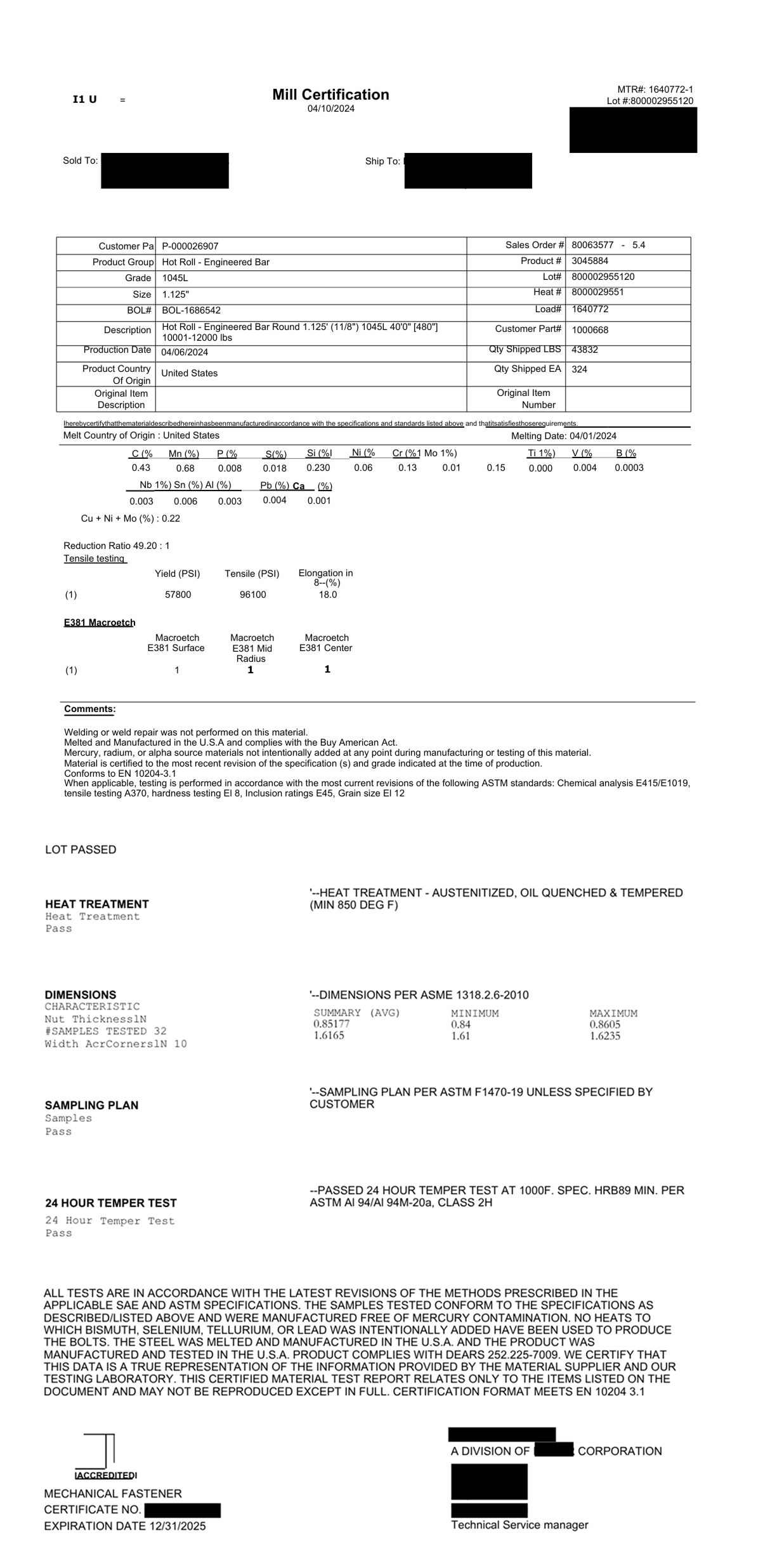
Identification. The manufacturer, the part, the specification, the lot number and the heat number, plus the numbers tying the document to your order: their sales order, your purchase order, your part number, the quantity shipped and the production lot it came out of. Melt, manufacture and ship dates too.
Lot and heat are different numbers. The heat identifies the melt of steel; the lot identifies the run of finished parts made from it. Your box is normally labeled with the lot, and the certificate ties that lot back to a heat.
Raw material, listed separately. Grade, heat number, and the steel supplier's name. A good package has that supplier's own mill certification attached behind the fastener certificate, so you can follow the chain from the part in your hand back to the melt.
Chemical analysis. The measured percentage of each element the spec governs, each inside the allowed limits. Note whether it's the fastener maker's own test or the heat analysis passed through from the steel mill; certificates normally say.
Mechanical properties. Whatever the spec requires for that part, which differs by product. Nuts get proof load and hardness, often several readings and an average. Bolts get tensile, yield and elongation.
Heat treatment, dimensions, sampling and surface. The condition the parts were processed to. Measured dimensions against the dimensional standard, with the number of pieces checked and the minimum, maximum and average for each. The standard governing how many were pulled. A visual result against the surface-discontinuity standard.
Origin and compliance statements. Where the steel was melted and where the parts were made and tested, plus any language your contract requires, such as Buy American or the defense rules on specialty metals.
Test methods, lab accreditation and signature. The standard each test was run to, often the lab's accreditation number and expiration date, and a named person with a title attesting the results. Many add that it may not be reproduced except in full.
What to check, in order
You don't need to understand metallurgy. You need to compare four things.
Do the numbers on the certificate match what's on the box? The lot number on your packaging should appear on the certificate, and the certificate should tie that lot back to a heat. If the packaging, the packing slip and the certificate don't tie together, nothing else on the page matters, because you can't prove the document describes your material.
Does the specification on the certificate match your purchase order? Read the grade and standard on the cert and compare it to what you actually bought. Not what you assumed you bought. What the PO says.
Do the measured values fall inside the spec limits? You don't have to know why the limits exist, only that each reported number sits within the range printed alongside it, or in the standard.
Who issued it? The manufacturer's own document is the strongest one. A certificate retyped onto someone else's letterhead is weaker, because every transcription is a chance to break the chain back to the melt. A distributor handling this well passes the original through and adds its own paperwork for any processing it did, rather than replacing what the manufacturer issued.
The red flags
A few patterns should slow you down.
No heat number at all. You can't connect the paperwork to the parts. Reject it and ask again.
A heat number that doesn't appear on the material or the packaging. Same problem from the other direction.
The certificate names one specification and the packing slip names another. Somebody substituted, or somebody made a clerical error. Find out which before the parts go into a job.
Every measured value sitting exactly at the minimum. Real production data varies. A page of results that all land precisely on the allowable limit is worth a second look and a phone call.
A supplier who can't or won't produce the document. For material where traceability matters, that's the answer to your question.
Getting it right at the purchase order
Most cert problems are created weeks before receiving, on a purchase order that didn't ask clearly.
Say what you want by name. "Mill test report required" is unambiguous. "Certs required" is not, and you'll get whatever the supplier's system produces by default. Specify that the lot and heat numbers must appear on the packaging so receiving can tie it out without a phone call. Say the certificate must ship with the material, since chasing paperwork afterward is its own job. And if a job needs traceability, say so at quote time, because it affects which material a distributor pulls from.
A distributor who knows up front that a job needs traceability will source it differently than one filling a routine order. It's a cheap thing to say and an expensive thing to fix afterward.
We supply material certifications on request across the structural fasteners we stock, and on parts made to order for a specific job, where the paper trail usually matters most. If you're not sure what your customer's quality requirement actually calls for, ask upfront.
For material certifications, traceable stock, or help writing cert requirements into your next purchase order, contact us.
